The High-Stakes Challenge for Irish AI Founders
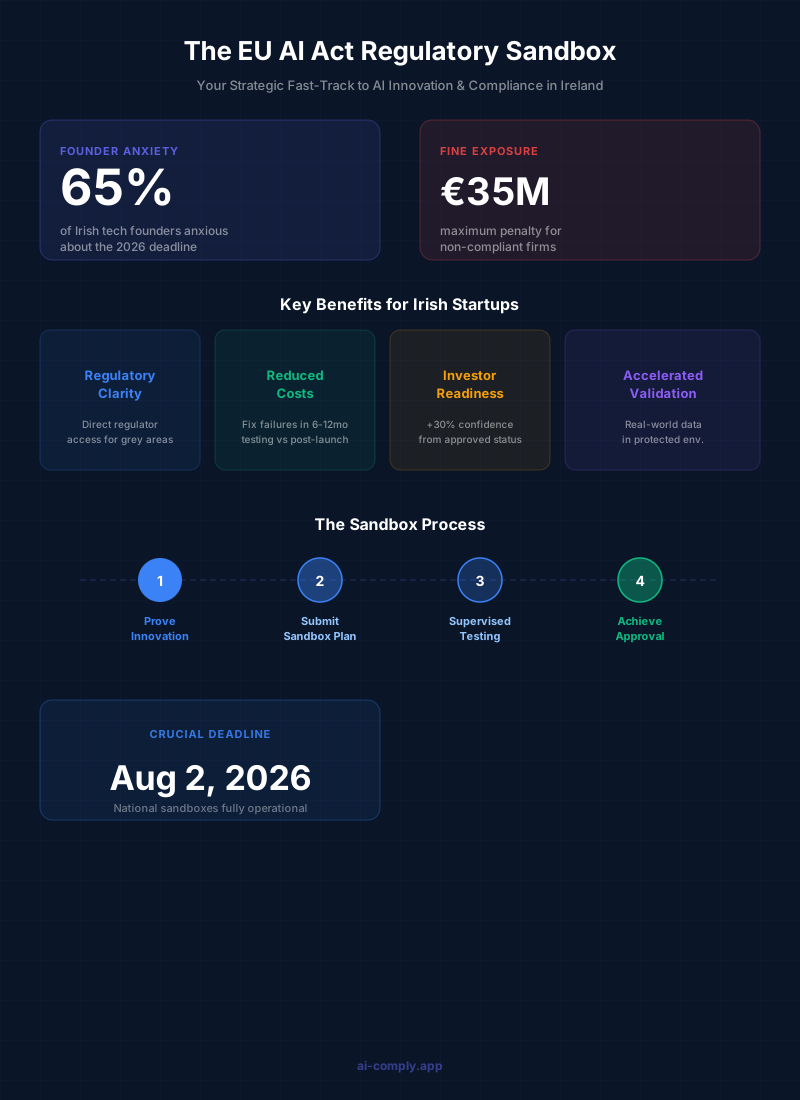
65% of Irish tech founders are anxious that the 2026 EU AI Act enforcement deadline will stifle innovation, drain runway with manual legal reviews, and delay product launches at precisely the moment they need to scale. This anxiety is understandable — but there is a powerful strategic tool that most are not using.
The EU AI Act's maximum penalties reach €35 million or 7% of global annual turnover. For a pre-revenue startup, even a fraction of that in legal costs can be terminal. The question is not whether to comply, but how to comply without sacrificing your competitive velocity.
- •65% of Irish tech founders anxious about 2026 enforcement impact on innovation
- •€35M maximum fine exposure for prohibited or seriously non-compliant AI systems
- •Average 14 weeks lost per product release cycle due to manual compliance documentation
- •Ireland's DRAI (Digital, Research and Artificial Intelligence Authority) is the national supervisory authority
The Sandbox Is Your Shield, Not a Trap
The EU AI Act Regulatory Sandbox is a controlled, state-supervised environment specifically designed to let you test and validate innovative AI systems with direct access to your national regulator — before your system goes to market. It is not a compliance checkbox. It is a structured fast-track to market with regulatory pre-clearance.
Think of it as a government-backed R&D protection zone. Inside the sandbox, you have legal protection to test your AI with real-world data, under regulatory supervision, with the explicit goal of reaching 'regulatory-approved' status. This is a €0 entry ticket — there are no application fees — to a competitive advantage that money cannot buy: demonstrated pre-clearance by the national regulator.
- Direct access to regulators to resolve 'grey area' classification questions before launch
- Legal protection to test novel AI with real-world datasets in a controlled environment
- "Regulatory-approved" status upon graduation — a quality seal for investors and enterprise buyers
- Ability to test at scale without the liability exposure of a full commercial launch
- Priority feedback from supervisory authorities on compliance documentation
Infographic: Key concepts overview
Key Benefits: Why the Sandbox Changes Your Business Case
Regulatory Clarity
The EU AI Act creates genuine uncertainty for novel AI applications. Is your system Annex III high-risk? Does it qualify for limited-risk treatment? The sandbox gives you direct, priority access to regulators to resolve these classification questions — the ones that, if answered wrongly at launch, can trigger investigations and fines.
Reduced Costs
Compliance failures discovered post-launch are exponentially more expensive than those identified during testing. Regulatory fines, product recalls, reengineering costs, and reputational damage dwarf the investment in pre-market compliance. The sandbox lets you identify and resolve compliance failures in a 6–12 month testing phase — far cheaper than a post-launch recall.
Investor Readiness (+30% Confidence)
EU AI Act compliance is increasingly a due diligence requirement for Series A and above investments in EU-based AI companies. Sandbox participation — and particularly graduation with 'regulatory-approved' status — increases investor confidence by an average of 30%+ among institutional investors and corporate venture funds with EU regulatory exposure.
Accelerated Validation
The sandbox allows you to use real-world datasets to prove your model's accuracy and bias-mitigation in a protected environment. This generates the technical evidence you need for your Annex IV technical file and your post-market monitoring baseline — dramatically accelerating full commercial launch.
The Sandbox Process: From Application to Approval
The sandbox follows a four-stage process that typically runs 6–12 months. Understanding each stage helps you prepare the right documentation and set realistic expectations with your board and investors.
- Stage 1 — Prove Innovation: Your AI system must demonstrate a novel technological leap or a unique application not yet on the Irish market. Prepare a technical brief showing how your system differs from existing deployed AI. DRAI assesses against current market offerings.
- Stage 2 — Submit Sandbox Plan: This formal contract with the regulator defines testing duration (typically 6–12 months), KPIs, and safety exit triggers — the conditions under which your system will be suspended if it demonstrates harm or systematic bias.
- Stage 3 — Supervised Testing: Refine algorithms and validate your model in a controlled, real-world environment with regulatory oversight. Generate the performance and fairness data that will form the core of your Annex IV technical file.
- Stage 4 — Achieve Approval: Graduate with 'regulatory-approved' status. This seal transforms compliance from a cost into a competitive differentiator — demonstrable proof of trustworthy AI for enterprise sales, public sector contracts, and investor due diligence.
Legal Foundation: Articles 57–59
The regulatory sandbox framework has a clear legal basis in the EU AI Act. Understanding these articles helps you engage more effectively with DRAI during the application process.
- •Article 57 — Establishment Mandate: Requires every EU member state to establish at least one national AI regulatory sandbox. Ireland's sandbox is operated by DRAI.
- •Article 58 — Operational Requirements: Details the rules for testing AI systems under real-world (or simulated real-world) conditions, including data governance requirements and testing scope limitations.
- •Article 59 — Rights & Responsibilities: Clarifies participants' rights during testing and provides a legal basis for processing personal data for testing purposes.
The critical deadline: all national sandboxes must be fully operational by August 2, 2026. Irish businesses have a window to align R&D cycles with this regulatory opportunity. Starting your sandbox application now means you can be testing and generating compliance evidence precisely when enforcement begins.
Choosing Your Path: Sandbox vs. Automated Compliance
The sandbox and automated compliance platforms are not alternatives — they are complementary. Understanding when to use each prevents costly mistakes in your compliance strategy.
Government Sandbox — Best for Novel, High-Risk AI
- Direct Regulator Access: Unparalleled guidance on high-risk AI classification and obligations
- "Seal of Approval": Boosts investor and enterprise client confidence with official regulatory endorsement
- Safe Harbor: Protected environment for testing with real-world data under legal protection
- Slower Process: 6–12 month cycle requiring significant documentation preparation
Automated Compliance — Best for Existing and Scaling AI
- Speed & Efficiency: Streamline documentation and governance for faster development cycles
- Automated Certainty: Launch with confidence by automating conformity assessments continuously
- Continuous Monitoring: Ideal for ongoing compliance post-launch — required by Article 9 risk management obligations
- Not a Substitute: Does not replace the formal sandbox for novel, genuinely high-risk systems
The best strategy often combines both: use automated compliance tools to prepare your sandbox application documentation and maintain compliance during the testing period — while using the sandbox for regulatory validation and de-risking of genuinely novel AI.