The Cost of Non-Compliance Is No Longer Theoretical
For the past two years, EU AI Act compliance has been largely voluntary — a compliance framework in build mode. That changes on August 2, 2026. This date marks the transition from preparation to active enforcement, and Irish businesses that have relied on annual audits, static documentation, or 'wait and see' strategies now face real legal exposure.
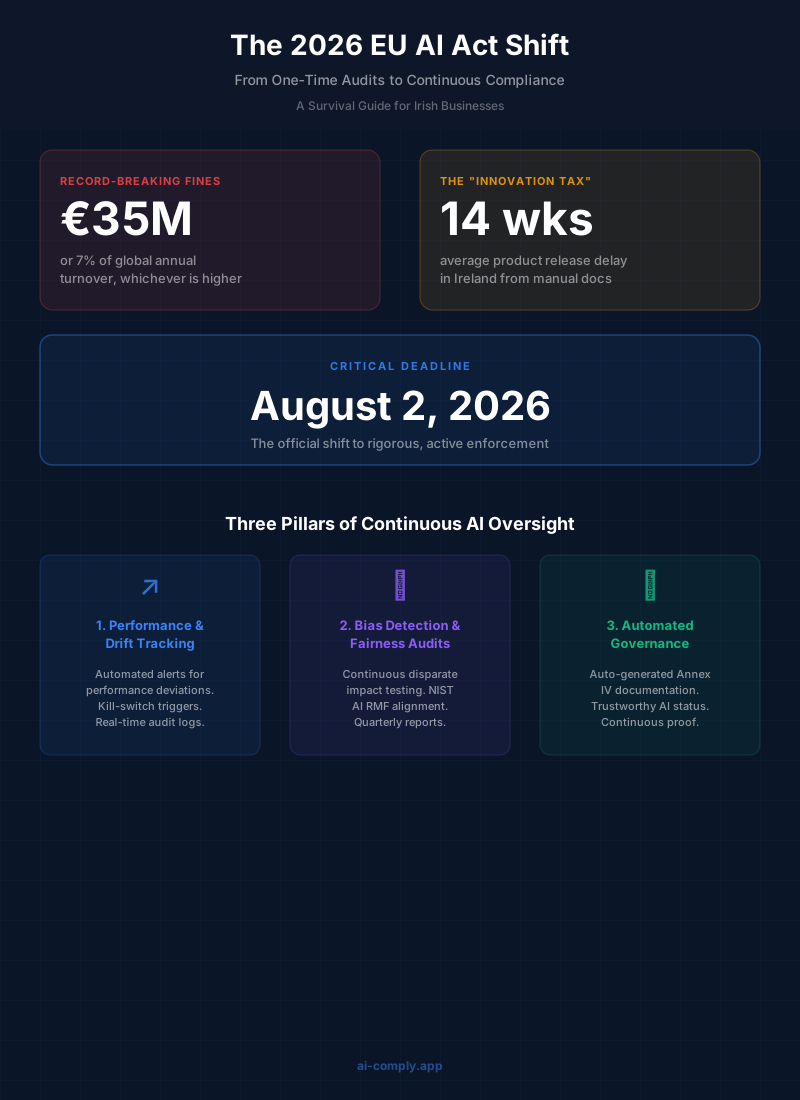
The financial stakes are unambiguous. Non-compliant organisations face fines of up to €35 million or 7% of global annual turnover — whichever is higher. For a mid-sized Irish tech company with €50M annual global revenue, that translates to a potential €3.5M fine per violation. For companies operating AI in high-risk domains (recruitment, credit scoring, public services, medical devices), the exposure is compounded by the volume of systems in scope.
- •Fines up to €35M or 7% of global annual turnover for prohibited AI violations
- •Fines up to €15M or 3% of global annual turnover for high-risk AI non-compliance
- •Fines up to €7.5M or 1.5% of global annual turnover for incorrect information to supervisory authorities
- •Average 14-week product release delay in Ireland due to manual documentation processes
The 'Innovation Tax' — the compliance overhead that slows AI-powered product development — is already being felt. Irish tech founders report that manual compliance processes are consuming engineering sprints, delaying go-to-market, and creating unpredictable regulatory risk at the worst possible time: during fundraising and scale.
Why Static Audits Are Now Worthless
The EU AI Act is not a GDPR compliance checkbox. It is a living, operational framework designed to govern AI systems as they behave in production — not as they were described in a document written six months before launch.
The critical failure of the 'one-and-done' audit model is that it captures a snapshot of your AI system at a single point in time. But AI systems drift. Models trained on historical data diverge from current reality. Bias patterns emerge as real-world populations interact with your system. Accuracy degrades silently. A PDF report signed off in January tells you nothing meaningful about what your model is doing in October.
The Past: Static Assessment
- "One-and-done" checklist approach — compliance confirmed once, assumed forever
- Relies on manual annual reviews and static PDF documentation
- Fails to capture model drift or emerging bias patterns in real-time
- Cannot demonstrate continuous conformity to supervisory authorities
- Directly contradicts Annex IV requirements for ongoing technical documentation
- Worthless in 2026: direct violation of Article 9 (risk management) and Article 26 (deployer obligations)
The Future: Continuous Monitoring
- Persistent legal and technical oversight as AI systems operate in production
- Automated, live stream of performance and compliance data
- Instantly identifies deviations to prevent legal exposure before incidents occur
- Mandatory for high-risk systems to prove conformity 24/7 to national supervisory authorities
- Enables post-market monitoring (Article 72) with automated log generation
- Supports human oversight obligations (Article 26) with real-time intervention triggers
Infographic: Key concepts overview
The Three Pillars of Continuous AI Oversight
Building a continuous compliance programme requires three interconnected capabilities. Each addresses a distinct failure mode that static audits cannot detect. Together, they create what regulators are looking for: a demonstrable, auditable record of ongoing compliance.
1. Performance & Drift Tracking
AI models trained on historical data will inevitably diverge from current reality as the world changes. This 'model drift' is not a bug — it is an inherent property of machine learning systems. The question is not whether drift occurs, but whether you detect it before it creates harm or regulatory violations.
- •Set automated alerts for performance deviations against defined KPIs
- •Establish hard "kill-switches" — automatic system suspension if accuracy drops below defined thresholds (e.g., < 92%)
- •Integrate performance logs into real-time documentation with timestamped audit trails
- •Schedule regular retraining triggers when drift exceeds acceptable variance
2. Bias Detection & Fairness Audits
High-risk AI systems operating in employment, credit, education, or public services must demonstrate fairness across protected characteristics. The EU AI Act's Annex III obligations, combined with Ireland's Equal Status Acts and GDPR, create a layered compliance framework that requires continuous fairness monitoring — not just pre-launch testing.
- •Implement frameworks aligned with NIST AI RMF for systematic bias detection
- •Conduct continuous disparate impact testing across protected groups
- •Ensure model outputs do not violate Equal Status Acts across gender, age, ethnicity, disability
- •Generate quarterly fairness reports as part of your post-market monitoring plan
3. Automated Governance
The most sustainable compliance programmes treat governance as infrastructure, not overhead. Automated governance transforms raw system logs into a continuously updated, audit-ready compliance record — without manual intervention for every entry.
- •Generate Annex IV technical documentation automatically from system metadata and logs
- •Ensure transparent, traceable, and logged decision records for every high-risk output
- •Maintain "trustworthy AI" status with continuous conformity proof accessible to supervisory authorities
- •Automate incident detection and 72-hour notification triggers under Article 73
Building Your Continuous Compliance Infrastructure
The practical challenge for most Irish organisations is not understanding what continuous compliance requires — it is building it without a dedicated 20-person legal and engineering team. The good news is that purpose-built compliance platforms now make continuous oversight accessible to SMEs.
- Register all AI systems in scope under EU AI Act with risk classification documentation
- Implement monitoring hooks that feed real-time performance data into your compliance record
- Configure automated alerts for the specific thresholds relevant to your high-risk domain
- Connect human oversight protocols with clear escalation paths for system suspension
- Generate post-market monitoring reports on a quarterly basis with automated data feeds
- Maintain version-controlled technical documentation that updates as your system evolves
The organisations that will navigate 2026 enforcement successfully are those that build compliance into their AI development lifecycle now — not those scrambling to produce documentation when an audit notice arrives.
What Irish Businesses Must Do Before the Deadline
The critical path for Irish organisations is shorter than most realise. Here is the prioritised action list for the next 90 days.
- Conduct a full AI inventory audit — identify every AI system your organisation deploys or uses that falls within EU AI Act scope
- Classify each system by risk tier using the Annex III criteria — a task that platform tooling can automate in hours rather than weeks
- Identify your role in each system's value chain — are you a provider, deployer, or both?
- For high-risk systems, begin Annex IV technical file documentation immediately
- Establish human oversight mechanisms for all high-risk deployments with named responsible persons
- Implement post-market monitoring plans with defined performance KPIs and deviation thresholds
- Prepare incident response procedures for the 72-hour notification requirement under Article 73
The August 2026 deadline is not a cliff edge — supervisory authorities across the EU are already active. Ireland's Data Protection Commission has made clear that AI Act enforcement is a 2026 priority. The question is not whether to act, but how quickly you can build a defensible compliance posture.